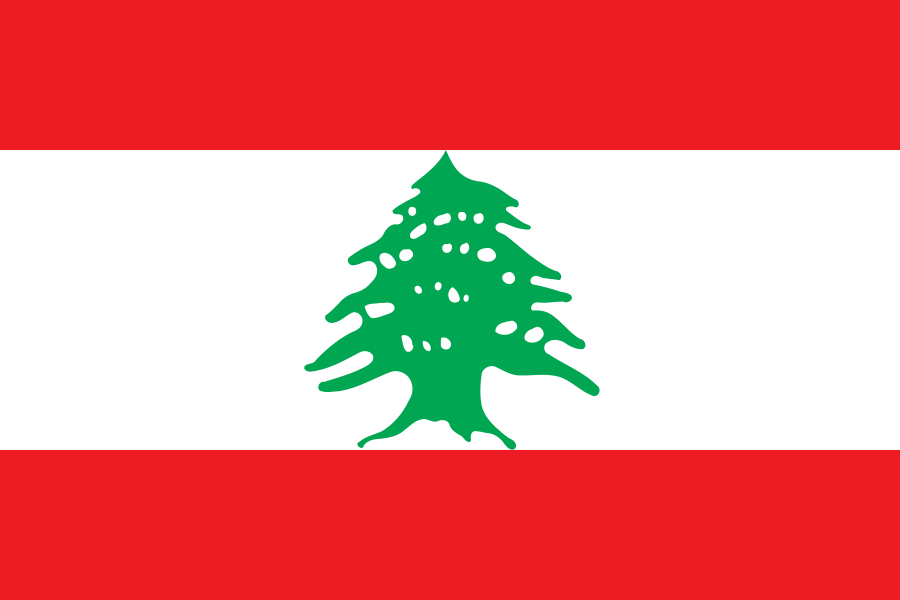
Lebanon
Asia · Beirut · LB
Lebanon is the small, ancient country of the eastern Mediterranean, a land of cedar mountains, Roman ruins and a capital that for decades held the heart of the Arab world's glamour. Beirut, rebuilt after its wars, mixes the nightlife of Gemmayzeh and the Corniche with the treasures of the National Museum and the lively lanes of the old souks. The ruins of Baalbek in the Bekaa Valley hold some of the greatest Roman temples ever built, and the old ports of Byblos, Tyre and Sidon keep the Phoenician and the crusader layers of the coast. The cedars of the mountains and the ski slopes of the interior sit only an hour from the beaches of the summer. Complex, resilient, beautiful and warm beyond the headlines, Lebanon packs a huge history into a very small country, and the green plain of the Bekaa between its two mountain ranges adds a fertile heart to the picture.
Overview
Lebanon is a country in Asia. Its capital is Beirut and the international dialling code is +961. Languages commonly used in everyday life here include Arabic and French. Local currency is the Lebanese Pound (LBP). Our guide covers 1 airport, including Beirut–Rafic Hariri International Airport. We also list 1 city in Lebanon: Beirut.
The Roman Temples of Baalbek and the Stones of the Gods
The ruins of Baalbek, in the broad Bekaa Valley, hold some of the largest and best-preserved Roman temples ever built, the complex dedicated to the gods of the mountains with stones so massive that even the builders of later ages could barely move them. The temple of Bacchus, still standing with its columns and its carved interior, is the best preserved of the great temples of the Roman world, and the temple of Jupiter rises on its podium above the valley, its six surviving columns the tallest of the acropolis. The quarry of the site holds the famous stone of the pregnant woman, one of the largest worked stones in the world, and the whole place has the atmosphere of a shrine where the empires of the ancient East and West met. Baalbek is one of the supreme archaeological experiences of the Levant.
Beirut, the Corniche and the Nights of Gemmayzeh
The capital of Beirut spreads its life along the seafront Corniche, the long promenade where the joggers, the families and the fishermen share the wave-beaten railing and the view across the Mediterranean. Behind the shore the city layers its identities in a dense, walkable centre: the ruins of the old Roman and medieval quarters exposed in the modern districts, the rebuilt souks and the galleries of the contemporary scene, and the hill quarters of Gemmayzeh and Mar Mikhael with their bars, their staircases and their famous nightlife. The National Museum, with its great sarcophagi and its Phoenician treasures, holds the depth of the story. Beirut is a city of layers, of appetites and of a resilience that the traveller feels in the very liveliness of its evenings.
Byblos and the Oldest Port of the Mediterranean
The coastal town of Byblos claims a continuous history of more than seven thousand years, making it one of the oldest continuously inhabited towns in the world, and its layered ruins climb the low hill above the small harbour of the Lebanese coast. The crusader castle of the hill looks down over the excavated quarters of the Bronze Age city, the temples, the tombs and the great wall of the earliest town, while the lanes below run between the old stone houses, the galleries and the restaurants of the fishing port. The little port itself, with its sea-facing cafes and its fishing boats, is the picture-postcard heart of the town, and the evenings along the waterfront are some of the most pleasant in the country. Byblos is the clearest place in Lebanon to feel the full depth of the Middle East's age.
The Cedars of the Mountains and the Heights of the Ski
The mountains of Lebanon, the great range that runs parallel to the coast, hold the famous cedars of the country, the great, ancient trees of the forest that are its national emblem, standing in their protected groves above the town of Bsharri. The grove of the cedars, some of them more than a thousand years old, sits in the high, cool air at almost two thousand metres, and the walk through the ancient trunks amongst the silence of the upper forest is a pilgrimage for the whole country. In the winter the resorts of the range, with the ski slopes reaching within an hour of the capital, turn the mountains white, and in the summer the same slopes are the hiking grounds of the spring flowers and the cedar shade. The mountains give Lebanon its green crown and its cool retreat.
The Mezze Table and the Long Feast of the Coast
Lebanese food is one of the great cuisines of the world, and the meal runs on the mezze, the small plates of the table that arrive in a long, deliberate parade: the hummus, the tabbouleh, the grilled halloumi, the kibbeh, the stuffed vine leaves, the foul, the dips, the pickles and the fresh herbs of the farms. The grilled meats of the skewers and the seafood of the coast follow, and the leaves of the flatbread, the salad and the olive oil keep everything moving. The sweets of the feast, the pastry of the ka'ak and the cream of the muhallebi, close the meal, and the coffee and the arak keep the table talking late. To eat in Lebanon is to join a long, loud, generous conversation that no one tries to hurry.
Compare hotels, cover your trip and stay connected.
- Capital
- Beirut
- Currency
- Lebanese Pound (LBP)
- Languages
- Arabic, French
- Calling code
- +961
- Internet TLD
- lb
Entry requirements
Check who can enter →See which passports travel visa-free or need a visa to enter Lebanon.
Airports (1)
All airports →Cities (1)
All cities →Frequently asked questions
What is the capital of Lebanon?
Beirut is the capital of Lebanon, and the country sits in Asia.
What currency is used in Lebanon?
You pay with Lebanese Pound (LBP) in Lebanon. Exchange rates move day to day, so check the current rate before you change money or use your card abroad.
Which languages do people speak in Lebanon?
The languages we list for Lebanon are Arabic and French. A couple of greetings in the local language go a long way when you travel, even in cities where another language is widely used.
What is the international dialling code for Lebanon?
The dialling code for Lebanon is +961 — keep the plus sign when you save the number.
Which airports serve Lebanon?
Beirut–Rafic Hariri International Airport (BEY) in Beirut is the airport we cover for Lebanon.
Which cities in Lebanon do you cover?
Our guide lists 1 city for Lebanon: Beirut (capital).