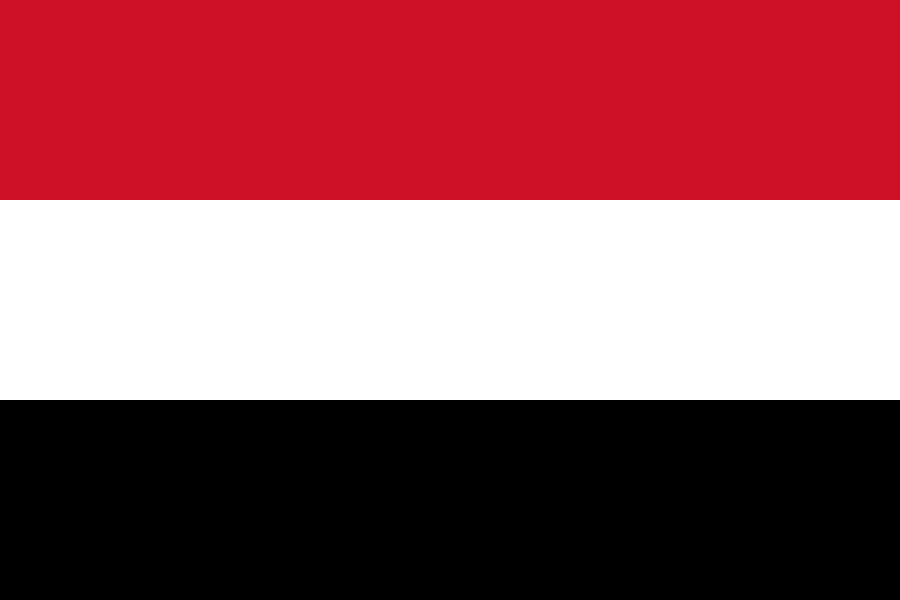
Yemen
Asia · Sanaa · YE
Yemen is the storied, ancient country of the south-west corner of the Arabian Peninsula, a nation of the dramatic mountains, the deserts and the coasts that holds some of the most extraordinary human and natural heritage of the Arab world. The historic land of the incense and the coffee, whose frankincense caravans and whose ancient kingdoms of the Sabaean and the Himyarite left their temples, their dams and their treasure across the highlands, is today a country of tragic conflict and extraordinary patience, its people hungering for the peace of their wounded land. The towns of the country reveal the dazzling architectural wealth: the sky-scraping towers of the old city of the Sanaa, the mud-brick skyscrapers of the Shibam of the Hadhramaut and the tropical gardens of the port of the Aden, while the island of the Socotra, with its dragon blood trees, preserves a natural world found nowhere else. Ancient and infinitely rich, Yemen holds within its suffering one of the great civilizational treasures of the Arabian Peninsula.
Overview
Yemen is a country in Asia. Its capital is Sanaa and the international dialling code is +967. Languages commonly used in everyday life here include Arabic. Local currency is the Yemeni Rial (YER). We also list 1 city in Yemen: Sanaa.
The Old City of the Sanaa and the Towers of the Town
The capital of the Sanaa, the extraordinary ancient city of the highlands that sits in its broad valley surrounded by the volcanic mountains and the terraced gardens, holds one of the oldest continually inhabited urban centres of the world and one of the marvels of the Islamic urbanism, a city of the moon. The old town, encircled by the ancient walls and studded with the corbelled windows of the gingerbread towers, climbs through the tall decorated houses of the sultans, marbled with the white alabaster, around the great mosque of the Bani and the splendid markets of the city with their silver and their saffron. The seven-storey mansions of the old town, with their courtyards and their painted window frames, and the milky white suburbs of the modern capital rising beyond the walls, preserve the domestic architecture of a beautiful and deeply endangered world capital.
The Skyscrapers of the Shibam and the Valley of the Hadhramaut
The town of the Shibam, the marvellous mud-brick city of the great valley of the Hadhramaut that rises as a single dense block of the tower houses from the floodable plain of the Wadi, is one of the most celebrated urban wonders of the world, a Manhattan of the desert where several hundred buildings of the rammed earth rise up to eight storeys high within the protective rectangle of the walls. The town, for centuries a wealthy trading citadel of the incense and the services of the Arabian south, is built almost entirely of the sun-dried brick, its clustered towers, with their elaborately decorated upper rooms and their heavy wooden doors, a complete architecture of the mud created against the floods and the heat of the valley. The neighbouring villages of the valley, with their minarets and their terraced flood gardens, complete the extraordinary mud-built landscape of the Hadhramaut.
The Port of the Aden and the Crater of the Harbour
The port city of the Aden, the historic deep-water harbour of the country's south that sits within the crater of an old volcano on the rocky promontory of the coast, has served the shipping of the Indian Ocean and the Red Sea since the classical world. The natural crater harbour of the town, ringed with the sheer black walls of the old volcano and filled with the anchored ships of the modern port, gives the city its unique topographical drama, and the old quarter of the town, with its stepped lanes, its minarets and its basket markets of the ancient port, preserves the layered history of the trade of the southern seas. The beaches and the viewpoints of the promontory, and the extraordinary tank cisterns of the ancient water collection of the town, complete the strange, volcanic port that straddles the age-old sea route between the East and the West.
The Island of the Socotra and the Trees of the Dragon
The island of the Socotra, the great isolated outlier of the country that floats far out in the ocean off the horn of the Africa, is one of the most biologically extraordinary places on the planet, a living museum of the plants and the animals that evolved nowhere else in the whole of the world. The strange dragon blood trees of the island, the umbrella-shaped trees that bleed the red resin of their name, dot the rock valleys and the highland plateaux of the island in one of the most alien landscapes of the earth, alongside the giant bottle trees and the frankincense of the cliffs. The limestone caves and the white sand beaches of the island, with its turtles, its birds and its island villages of the frankincense trade, give the astonishing and fragile world of the Socotra, protected as one of the great natural heritages of the world.
The Terraces of the Highlands and the Fortresses of the Mountains
The western highlands of the country, the jagged chain of the great escarpment mountains that catches the monsoon clouds and descends in the mile-high terraces to the coastal plain, hold some of the most beautiful agricultural and defensive landscapes of Arabia. The extraordinary terraces of the mountains, the ancient stone-built fields that climb the steep slopes with their grain, their coffee and their qat, are the hanging gardens of the highlands, engineering marvels built and rebuilt across the centuries by the farmers of the escarpment. The fortress villages and the citadels of the region, from the great fortified town of the Thula with its walls and its watchtowers to the rock castle of the capital of the south, crown the peaks of the highlands in the unforgettable defensive architecture of the Yemeni mountains.
Compare hotels, cover your trip and stay connected.
- Capital
- Sanaa
- Currency
- Yemeni Rial (YER)
- Languages
- Arabic
- Calling code
- +967
- Internet TLD
- ye
Entry requirements
Check who can enter →See which passports travel visa-free or need a visa to enter Yemen.
Cities (1)
All cities →Frequently asked questions
What is the capital of Yemen?
Sanaa is the capital of Yemen, and the country sits in Asia.
What currency is used in Yemen?
You pay with Yemeni Rial (YER) in Yemen. Exchange rates move day to day, so check the current rate before you change money or use your card abroad.
Which languages do people speak in Yemen?
The languages we list for Yemen are Arabic. A couple of greetings in the local language go a long way when you travel, even in cities where another language is widely used.
What is the international dialling code for Yemen?
The dialling code for Yemen is +967 — keep the plus sign when you save the number.
Which cities in Yemen do you cover?
Our guide lists 1 city for Yemen: Sanaa (capital).