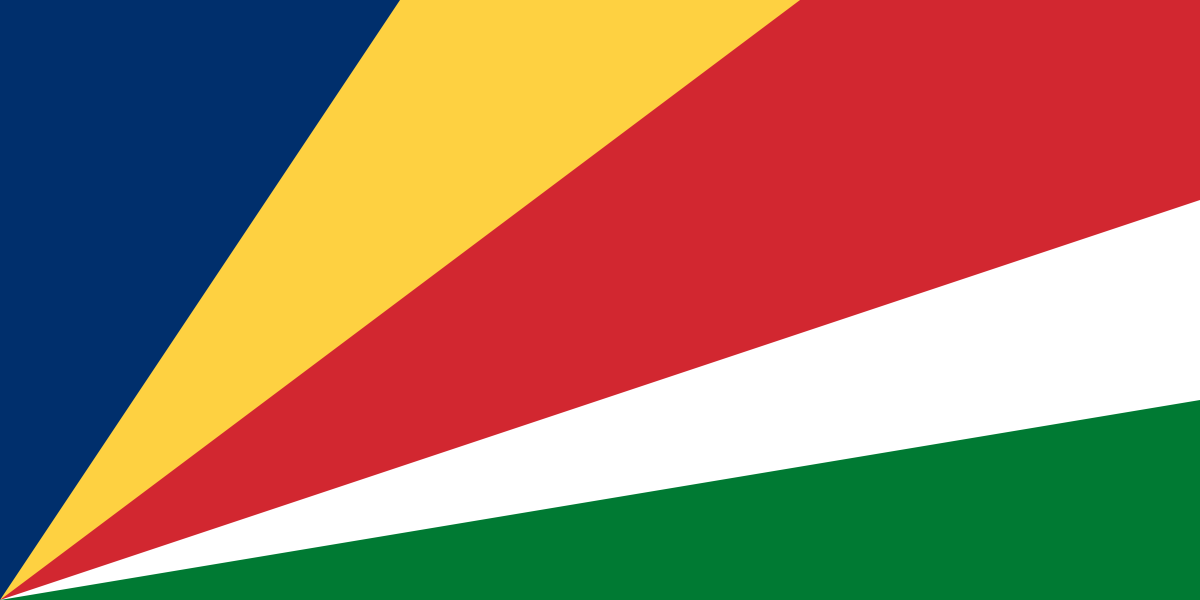
Seychelles
Africa · Victoria · SC
The Seychelles archipelago is a constellation of 115 islands scattered across the Indian Ocean, where granite boulders draped in tropical greenery frame beaches of impossible white sand and water so clear that fish cast shadows on the seabed. Mahé, the largest island, is a mountainous jungle interior surrounded by coves and fishing villages where Creole culture thrives in the form of sega rhythms, grilled fish stands, and painted colonial cottages. Praslin holds the Vallée de Mai, a UNESCO-listed palm forest where the endemic coco de mer produces the world's largest seed, while La Digue's Anse Source d'Argent is routinely named the most photographed beach on Earth. The Seychellois Creole language weaves together French, English, and African influences, and the cuisine reflects this hybridity: grilled red snapper with ladob, a sweet coconut dessert, or simple breadfruit chips fried roadside. The outer islands offer private coral atolls where giant tortoises roam freely and manta rays glide through crystal lagoons, creating a sense of remoteness that feels almost prehistoric.
Overview
Seychelles is a country in Africa. Its capital is Victoria and the international dialling code is +248. Languages commonly used in everyday life here include Seychellois Creole, English and French. Local currency is the Seychellois Rupee (SCR). We also list 1 city in Seychelles: Victoria.
Anse Source d'Argent on La Digue
Anse Source d'Argent, accessed through a coconut plantation on La Digue island, is a beach that defies description with its combination of rose-pink granite boulders, shallow turquoise pools, and fine coral sand that stays cool underfoot. The beach is segmented into private coves by the massive rock formations, each section revealing a different palette of blues and greens as light shifts throughout the day. At low tide, shallow lagoons extend hundreds of meters offshore, creating natural wading pools where starfish cling to sandy bottoms and small reef sharks patrol the shallows. The granite boulders, smoothed over millennia by wind and wave, form natural frames that photographers chase endlessly. La Digue itself is small enough to explore by bicycle, and the ride to the beach passes through vanilla plantations and past traditional ox-cart sheds.
Vallée de Mai and the Coco de Mer
The Vallée de Mai on Praslin Island is a primordial palm forest where the canopy of endemic Lodoicea maldivica trees filters sunlight into emerald dappled patterns on the forest floor. The coco de mer palm produces the largest seed in the plant kingdom, weighing up to 25 kilograms, and seeing these enormous heart-shaped nuts at the base of their parent trees feels like encountering a relic from another geological era. The forest is also home to the Seychelles black parrot, the national bird, whose soft calls echo through the understory. Walking the marked trails, visitors encounter giant geckos and endemic snails among the leaf litter. UNESCO designated the Vallée de Mai a World Heritage Site in 1983, recognizing its irreplaceable botanical significance. A guide's knowledge of the forest's pollination cycles and endemic species transforms a pleasant walk into an encounter with evolutionary history.
Morne Seychellois National Park on Mahé
Morne Seychellois National Park covers roughly 20 percent of Mahé Island, protecting the granite peaks, cloud forests, and coastal scrubland that form the island's mountainous spine. The park's highest point reaches 905 meters and offers sweeping views of the western coastline, where fishing villages dot the shores between white-sand coves. The Copolia Trail leads through misty mor apple forests to a summit viewpoint where the outer islands appear as dark shapes on the ocean horizon. Along the way, visitors encounter pitcher plants, giant millipedes, and the Seychelles sunbird flashing iridescent plumage between blossoms. The park also protects Mission Lodge, where freed slaves established a school in the nineteenth century, its stone ruins now surrounded by jungle. The combination of ecological richness and human history makes Morne Seychellois one of the most rewarding hikes in the Indian Ocean, offering physical challenge alongside deep contextual meaning.
Curieuse Island and Giant Tortoises
Curieuse Island, a short boat ride from Praslin, was once a leper colony and is now a marine park where over 300 Aldabra giant tortoises roam freely across red-earth clearings and mangrove trails. The island's Anse Badamier beach provides a sheltered anchorage where boats pull alongside granite outcrops, and visitors wade ashore to be greeted by tortoises lumbering toward outstretched hands offering leaves. The trail to the old leper settlement passes through mangrove tunnels where fiddler crabs wave oversized claws from muddy banks. The settlement's stone buildings, roofless but standing, tell the story of the colony's operation from 1829 to 1965. Snorkeling off Curieuse's northern shore reveals coral gardens teeming with parrotfish and butterflyfish, and the island's reefs are among the healthiest in the Seychelles. Curieuse combines wildlife encounter, historical reflection, and marine exploration into a single day trip that captures the archipelago's layered character.
Island-Hopping the Outer Atolls
Beyond the granitic inner islands, the Seychelles' outer coral atolls offer a completely different experience: flat, remote, and surrounded by some of the most biodiverse marine environments on the planet. Aldabra Atoll, a UNESCO World Heritage Site, is the world's second-largest raised coral atoll and home to over 100,000 giant tortoises that dwarf the human visitors who reach its shores. Bird Island hosts millions of sooty terns during the breeding season, the noise and movement creating a spectacle that overwhelms the senses. Desroches Island's 14-kilometer perimeter of unbroken white sand and surrounding reef is ideal for diving, where whale sharks gather between August and November. Getting to these outer islands requires small aircraft or extended boat journeys, and that remoteness is precisely the point: the atolls deliver an encounter with untouched ocean wilderness that the inner islands cannot replicate.
Compare hotels, cover your trip and stay connected.
- Capital
- Victoria
- Currency
- Seychellois Rupee (SCR)
- Languages
- Seychellois Creole, English, French
- Calling code
- +248
- Internet TLD
- sc
Entry requirements
Check who can enter →See which passports travel visa-free or need a visa to enter Seychelles.
Which nationalities can enter Seychelles?
Current visa status for tourism for the origins we cover, with links to the detailed requirements.









Cities (1)
All cities →Frequently asked questions
Do I need a visa to visit Seychelles?
For the origins we track, travellers from Morocco currently enter Seychelles visa-free for tourism. Entry rules depend on your passport and the purpose of your trip, so check the current requirements for your own nationality with our entry requirements tool.
What is the capital of Seychelles?
Victoria is the capital of Seychelles, and the country sits in Africa.
What currency is used in Seychelles?
You pay with Seychellois Rupee (SCR) in Seychelles. Exchange rates move day to day, so check the current rate before you change money or use your card abroad.
Which languages do people speak in Seychelles?
The languages we list for Seychelles are Seychellois Creole, English and French. A couple of greetings in the local language go a long way when you travel, even in cities where another language is widely used.
What is the international dialling code for Seychelles?
The dialling code for Seychelles is +248 — keep the plus sign when you save the number.
Which cities in Seychelles do you cover?
Our guide lists 1 city for Seychelles: Victoria (capital).