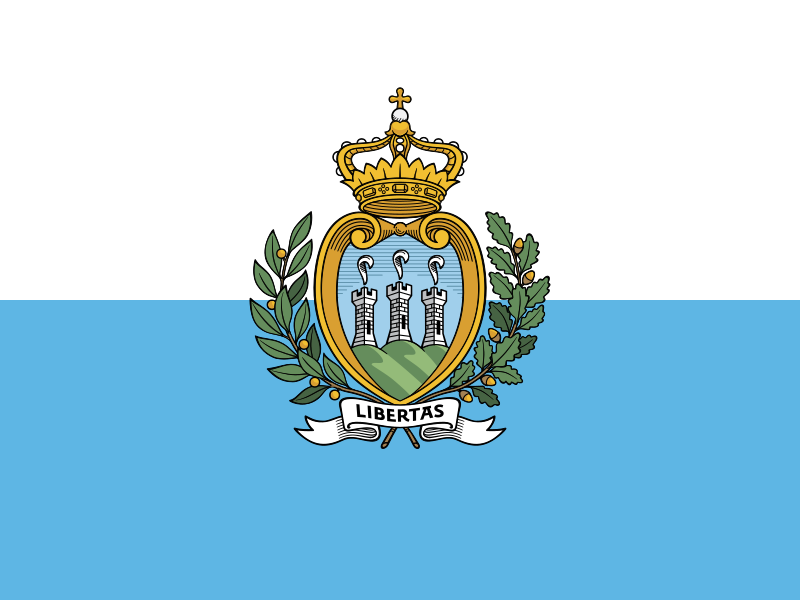
San Marino
Europe · San Marino · SM
San Marino is the tiny, ancient republic of the Italian peninsula that clings to the rugged peak of the Mount Titano, one of the smallest and the oldest sovereign states of the world, encircled entirely by the neighbouring regions of the Italy. The little country, whose independence stretches back more than seventeen centuries to the legend of a stonecutter saint, preserves its remarkable liberties on a mountain of barely sixty square kilometres of territory, its capital town built in stone on the terraces and the crags far above the plains of the Emilia-Romagna. It is a proud, self-contained world of the medieval towers of the summit, the cliff-hung palaces of the government, the ancient stone gates and the spectacular viewpoints over the hills and the sea of the Adriatic, and its citizens guard the identity of the oldest surviving republic of the world with an independence as firm as the rock of their mountain. Small, historic and extraordinarily defiant, San Marino is the living museum of the European freedom.
Overview
San Marino is a country in Europe. Its capital is San Marino and the international dialling code is +378. Languages commonly used in everyday life here include Italian. Local currency is the Euro (EUR). We also list 1 city in San Marino: San Marino.
The Towers of the Guaita and the Walls of the Summit
The three towers of the Mount Titano, the stone fortresses of the Guaita, the Cesta and the Montale that crown the triple peaks of the mountain, are the eternal symbols of the republic, the medieval watchtowers that have guarded the summit against the whole world for a thousand years. The two famous towers of the Guaita and the Cesta, the first built directly on the living cliff of the mountain, are linked by the dramatic path of the walls and the crags, and the second houses the marvellous museum of the ancient arms. From the terraces of the towers the entire panorama of the republic opens, the tiled old town, the peaks of the Apennines and, on the clearest days, the glimmer of the Adriatic coast, in one of the most extraordinary fortified urban settings of Europe.
The Stone Town of the Mountain and the Government of the Republic
The capital town of the country, the compact cluster of the stone palaces and the old houses that hangs on the terraces and the cliffs of the summit, is a perfectly preserved medieval centre, its narrow streets and its stairways climbing between the small squares and the lookouts of the mountain. The palace of the government, the Gothic town hall of the republic that stands on the square of the Liberty with its statue of the freedom, still hosts the ceremonies and the uniformed officials of the state, and the changeless rites of the electoral and the institutional life of the republic give the visitor the experience of a true working city-state. The museums of the town, the art collections and the curious historical galleries of the original republic, enrich the dense stone heart of the mountain capital.
The Stamps and the Coins of the Oldest Republic
The tiny republic, famous around the world for the extraordinary philatelic and numismatic production of its post offices and its mint, celebrates its independence through the stamps and the coins that collectors of the globe have prized for generations. The museum of the stamps and the coins of the state, in the heart of the old town, displays the marvellous history of the Sammarinese issues, from the early classical series to the modern commemorative editions, each stamp a little work of the art honouring the country's history, its art and its landscapes. The unusual fact that this mountain enclave of a few tens of thousands of citizens has issued some of the most beautiful and the most sought-after postal and monetary series of Europe gives the town's specialist shops and galleries their global collector's fame.
The Viewpoints of the Mountain and the Folletto of the Rock
The escarpments of the Mount Titano, the enormous limestone cliffs that drop from the summit terraces to the green valleys below, frame the country in every direction with their dramatic stone faces and their hanging walks. The paths of the rock, threading the cliffs, the crags and the viewpoints of the western escarpment, reach the celebrated natural ledges where the whole landscape of the republic spreads below, and the ancient taverns and the refreshment houses of the paths offer the local food and the wine of the region. The day trips of the rock, with their falcons and their rock plants, and the small villages of the lower slopes, give the complete natural frame of the world's most curious mountain republic.
The Festivals of the Crossbow and the Days of the Republic
The republic keeps alive the proud pageantry of its medieval liberties in the celebrations of the year, most famously in the festival of the crossbow and the great days of the medieval days of the country, when the old town rediscovers its costumed world of the banners, the archers and the infantry of the past. The competitions of the crossbow of the state, one of the oldest tournaments of Europe, draw the marksmen of the historic companies to the great square of the capital, dressed in the doublets and the colours of the medieval republic. The feast of the founding of the republic, on the day of the saint of the legend, with its torchlight processions and its festivals of the town, celebrates the seventeen centuries of the liberty of the world's oldest surviving republic.
Compare hotels, cover your trip and stay connected.
- Capital
- San Marino
- Currency
- Euro (EUR)
- Languages
- Italian
- Calling code
- +378
- Internet TLD
- sm
Entry requirements
Check who can enter →See which passports travel visa-free or need a visa to enter San Marino.
Which nationalities can enter San Marino?
Current visa status for tourism for the origins we cover, with links to the detailed requirements.
Cities (1)
All cities →Frequently asked questions
Do I need a visa to visit San Marino?
For the origins we track, San Marino requires a visa for tourism (Morocco: visa required). Entry rules depend on your passport, so confirm the current requirements for your own nationality with our entry requirements tool.
What is the capital of San Marino?
San Marino is the capital of San Marino, and the country sits in Europe.
What currency is used in San Marino?
You pay with Euro (EUR) in San Marino. Exchange rates move day to day, so check the current rate before you change money or use your card abroad.
Which languages do people speak in San Marino?
The languages we list for San Marino are Italian. A couple of greetings in the local language go a long way when you travel, even in cities where another language is widely used.
What is the international dialling code for San Marino?
The dialling code for San Marino is +378 — keep the plus sign when you save the number.
Which cities in San Marino do you cover?
Our guide lists 1 city for San Marino: San Marino (capital).