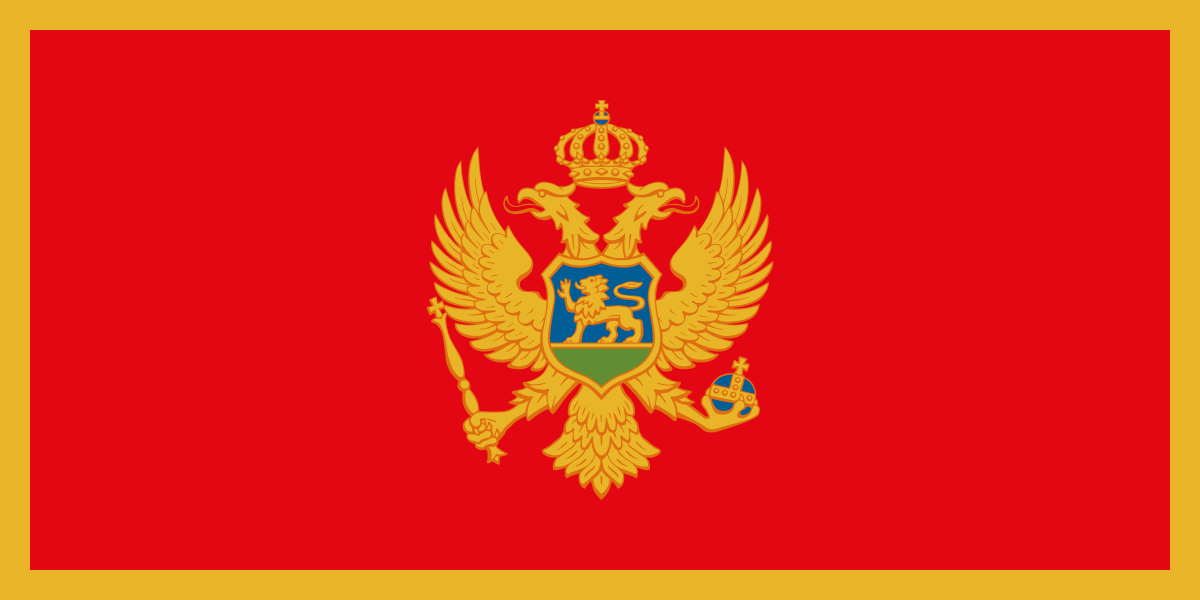
Montenegro
Europe · Podgorica · ME
Montenegro, whose name means black mountain, is a small country drawn along the Adriatic coast and the rise of the Dinaric Alps behind it. The Bay of Kotor, a set of natural inlets, wraps medieval villages in walls that climb cliff faces, and the seaside towns of Budva and Kotor have drawn visitors for centuries. Inland, the Durmitor massif peaks above glacial lakes and deep canyons, and the Tara River cuts one of the deepest gorges in Europe on its way past the country's great forest reserves. Lake Skadar, on the border with Albania, becomes alive with pelicans and marshland in spring. Montenegro's patchwork of Orthodox monasteries, Venetian towers and Muslim-era mosques reflects a coast that was never fully one nation's. The roads thread through mountains just as often as they run along the water, and the food, the wine and the hospitality follow the seasons of both the mountains and the sea.
Overview
Montenegro is a country in Europe. Its capital is Podgorica and the international dialling code is +382. Languages commonly used in everyday life here include Montenegrin. Local currency is the Euro (EUR). We also list 1 city in Montenegro: Podgorica.
The Natural Harbour Walls of the Bay of Kotor
The Bay of Kotor is often called a fjord, though geologically it is a flooded river valley, and its effect is just as sharp, with water that climbs into mountain walls and grips them for eighteen kilometres. Kotor's old town, a maze of narrow lanes and stone courts inside triple walls, presses against the innermost moat, and the castle walls carry a ladder of paths that climb to the fortress windows above the rooftops. The bay widens past the twin islets of Our Lady of the Rocks and Sveti Dorde, one a church on a natural islet and one built on a slowly sinking artificial island. Perast, opposite those islets, dozes into evening with baroque palaces and a waterfront that once hosted the Venetian fleet. The ferry between Kamenari and Lepetane shortcuts the inner bay, and every port town along the water rewards an arriving view.
The Ice-Cut Valleys of Durmitor
Durmitor is the country's mountain heart, a massif of peaks that stands inside the national park of the same name. The Black Lake, the most famous of the glacial tarns, lies an easy walk from the park town of Zabljak and mirrors the ridge in its cold water. The valley of the Tara River, which begins in the same highlands, drops into one of the deepest gorges on the continent, cut through limestone over millions of years. In summer the plateau turns to grazing country with meadows full of wildflowers, while winter buries it under deep snow drawn by skiers to the small slopes. Walking the ridge between the lakes keeps the views changing hour by hour, and the rock faces of Bobotov Kuk draw climbers through the short alpine summer. The river's rafting season runs from spring melt until early autumn on the wild sections.
The Coral-Hued Shores of Budva's Riviera
The coastal strip between Budva and Sveti Stefan is Montenegro's Riviera, a band of beaches, rocky coves and cypress-backed towns that has hosted summer visitors since the Venetians built here. Budva's walled old town crowds its tiny square with restaurants and towers, and the beaches at Jaz and Becici fan out either side of the castle promontory. Sveti Stefan, an island village turned into a resort, puts its pink-roofed houses on a peninsula connected by a narrow causeway, and the views from the mainland beaches frame it perfectly. The smaller settlements of Przno and Milocer keep the quieter coves, while Kamenovo hides under the cliff path that links the bays. Even the busiest stretches of sand give way quickly to the country's abrupt mountain backdrop. Summer evenings here are warm and loud, casting the lights across the water.
The Reedbed Corridors of Lake Skadar
Lake Skadar, shared with Albania, is the largest lake in southern Europe, and its Montenegrin side carries the marshland that makes it one of the bird world's great staging posts. The outlets near Virpazar and the village of Rijeka Crnojevica send small boat tours through channels of willow and reed, past heronries, osprey nests and the floating islands where the cormorants dry their wings. In spring the surface thickens with water lilies and the migrations pour through, while summer settles the water into a flat calm broken by the occasional boat. The white lilies and the pelicans are the lake's trademark sights, and the surrounding karst hills keep the water a deep bottle-green. The old monasteries along the shore tie the lake to the region's medieval history. On the water, with the mountains standing clear and the herons stepping over the shallows, Skadar feels enormous and ancient.
The Perched Pilgrimage Road to Ostrog
The Ostrog monastery, the white complex that clings to a vertical cliff face above the Zeta gorge, is one of the most striking religious sites in the Balkans. Pilgrims, Orthodox and Muslim both, walk the final stretch of road below the walls to arrive at the cave monastery that holds the relics of Saint Basil of Ostrog. The lower monastery, built into the gorge floor, gives over to an upper complex whose cells, church and courtyard seem to grow straight from the rock. The site draws tens of thousands each year, including many who travel the country on foot to reach it, and the cliff path offers one of the most theatrical approaches imaginable to a shrine. Driving in from the town of Danilovgrad, the white facades appear around a curve cut into the pale cliff, and the last ascent rewards a view out over the valley.
Compare hotels, cover your trip and stay connected.
- Capital
- Podgorica
- Currency
- Euro (EUR)
- Languages
- Montenegrin
- Calling code
- +382
- Internet TLD
- me
Entry requirements
Check who can enter →See which passports travel visa-free or need a visa to enter Montenegro.
Which nationalities can enter Montenegro?
Current visa status for tourism for the origins we cover, with links to the detailed requirements.









Cities (1)
All cities →Frequently asked questions
Do I need a visa to visit Montenegro?
For the origins we track, travellers from Australia, Canada, France, Germany and Italy currently enter Montenegro visa-free for tourism, and 3 more origins are visa-free too. Entry rules depend on your passport and the purpose of your trip, so check the current requirements for your own nationality with our entry requirements tool.
What is the capital of Montenegro?
Podgorica is the capital of Montenegro, and the country sits in Europe.
What currency is used in Montenegro?
You pay with Euro (EUR) in Montenegro. Exchange rates move day to day, so check the current rate before you change money or use your card abroad.
Which languages do people speak in Montenegro?
The languages we list for Montenegro are Montenegrin. A couple of greetings in the local language go a long way when you travel, even in cities where another language is widely used.
What is the international dialling code for Montenegro?
The dialling code for Montenegro is +382 — keep the plus sign when you save the number.
Which cities in Montenegro do you cover?
Our guide lists 1 city for Montenegro: Podgorica (capital).