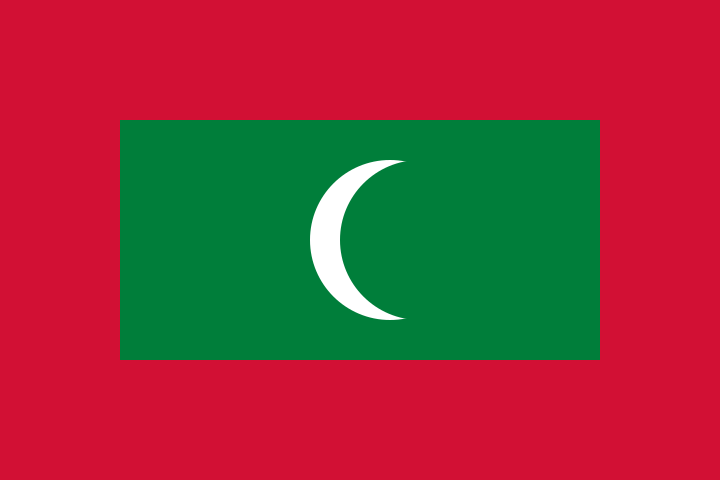
Maldives
Asia · Malé · MV
The Maldives is a string of nearly twelve hundred coral islands scattered across the Indian Ocean in twenty-six ring-shaped atolls, and the whole country sits low above a sea that changes from turquoise to deep indigo with the depth. Overwater villas on stilts line the house reef of the resort islands, while the local islands keep a slower life of fishing boats, sand paths and coral-stone houses. The capital Malé crowds its small island with markets, mosques and a harbour that never sleeps, and the connection island next door links the atolls by seaplane and speedboat. Below the surface the reefs hold manta rays, whale sharks and gardens of soft coral that make the Maldives one of the world's great diving destinations. Whether you come for a honeymoon villa, a surf break or a day of island hopping, the lagoon light and the friendliness of the people stay with you long after you leave.
Overview
Maldives is a country in Asia. Its capital is Malé and the international dialling code is +960. Languages commonly used in everyday life here include Dhivehi. Local currency is the Maldivian Rufiyaa (MVR). Our guide covers 1 airport, including Velana International Airport. We also list 1 city in Maldives: Malé.
The Atolls and Their Overwater Houses on Stilts
The resort islands of the Maldives take the idea of living on the water seriously, with rows of wooden villas raised on stilts above the house reef and steps that lead straight from the bedroom deck into the lagoon. Each villa usually carries a glass section in the floor where the fish pass beneath, and the morning swim begins with a single step off the terrace. Overwater jetties curve between the bungalows, and the reef at the end of the walkway drops into snorkel territory where parrotfish graze and rays shift across the sand. The engineering is clever: the islands are small, so everything arrives by boat, and the resorts desalinate their water and shoot their own solar power. Private dining platforms float over the water at some properties, and the night sky above the open ocean is among the darkest that travellers can still reach with relative ease.
Reef Shallows Where the Snorkeller Glides With the Rays
The house reefs of the atolls turn a simple snorkel into an underwater parade. Within a few strokes of the lagoon, the sandy bottom gives way to a wall of coral where damselfish, angelfish and clownfish dart among the branching staghorn. Eagle rays sweep across the sand in slow motion, and in the channels between islands the current brings schools of barracuda and the occasional turtle cruising the drop-off. The warmer months bring the plankton that feeds the manta rays, which glide and somersault through the cleaning stations at the reef edges. Guided snorkelling trips track these gatherings with respectful distance, and every resort keeps a marine biology team that briefs visitors before the first fin hits the water. The viewing is easy, shallow and warm enough that long hours in the water pass without notice and the light filters through the shallows in smoky blue shafts.
Malé's Fish Market and the Call to Prayer Over the Blue
Male, the crowded capital island, packs half the country's urban life into a space a few kilometres wide, and its early mornings belong to the fish market where the night's catch is laid out on wet table tops. Tuna, snapper, trevally and reef fish are slapped onto the slabs and filleted into steaks by hand as the auctioneers call their prices. Across the harbour the afternoon call to prayer echoes from the silver dome of the Old Friday Mosque, and the surrounding streets hold spice shops, tailors and stalls of dried fish bound for the outer atolls. The seafront promenade and the artificial beach offer a place to sit and watch the dhoni boats come and go between the wharf, the market and the islands. A wander through the narrow lanes of the old quarter reveals coral-stone houses, carved doorways and a pace that the resort islands never reproduce.
Dhivehi Cooking and the Coconut Trade of the Local Islands
Local island life in the Maldives follows the seasons of the fishing boats and the coconut palms that grow along every sandy shore. The kitchens cook mas huni, a breakfast mash of smoked tuna, coconut and lime, and serve fresh tuna curries with rice and roshi, the flatbreads pressed on a hot iron. Coconut is grated into everything, from the viscous sweetened milk of the drinks to the crumb that tops the sweet shortbread of the islands. Markets trade dried fish, palm toddy and island honey, and the big sociable ramps of the harbours become the meeting points where the morning's catch is talked over. Boduberu drums, wooden and raw, set the rhythm of village celebrations, and the kava-like sharing of sweet coconut water welcomes guests to the family tables. The pace is slow, the sea is the pantry, and the palm tops rattle in every breeze.
Sandbanks, Swim-Outs and the Full Moon on a Luminous Lagoon
Between the resort islands the reefs throw up long sandbanks that appear at low tide like empty beaches in the middle of the lagoon. Picnic boats anchor beside them and set up tables and shade sails where the morning party swims, snorkels and floats in water so clear it seems to stop at the seabed. The full moon gives the lagoon a second light, silvering the surface and drawing the planktons that gather in luminous swarms along the shorelines after dark. Swimming out from the sandbar, the drop-off turns the floor to deep indigo and the quiet of the open water swallows sound entirely. It is the empty, unbuilt version of the resort picture: sand, sea, sky and very little else. The perfect stillness of these islands is exactly what most visitors come to find, and the sandbanks deliver it in its simplest form.
Compare hotels, cover your trip and stay connected.
- Capital
- Malé
- Currency
- Maldivian Rufiyaa (MVR)
- Languages
- Dhivehi
- Calling code
- +960
- Internet TLD
- mv
Entry requirements
Check who can enter →See which passports travel visa-free or need a visa to enter Maldives.
Which nationalities can enter Maldives?
Current visa status for tourism for the origins we cover, with links to the detailed requirements.










Airports (1)
All airports →Cities (1)
All cities →Frequently asked questions
Do I need a visa to visit Maldives?
For the origins we track, travellers from Morocco currently enter Maldives visa-free for tourism. Entry rules depend on your passport and the purpose of your trip, so check the current requirements for your own nationality with our entry requirements tool.
What is the capital of Maldives?
Malé is the capital of Maldives, and the country sits in Asia.
What currency is used in Maldives?
You pay with Maldivian Rufiyaa (MVR) in Maldives. Exchange rates move day to day, so check the current rate before you change money or use your card abroad.
Which languages do people speak in Maldives?
The languages we list for Maldives are Dhivehi. A couple of greetings in the local language go a long way when you travel, even in cities where another language is widely used.
What is the international dialling code for Maldives?
The dialling code for Maldives is +960 — keep the plus sign when you save the number.
Which airports serve Maldives?
Velana International Airport (MLE) in Malé is the airport we cover for Maldives.
Which cities in Maldives do you cover?
Our guide lists 1 city for Maldives: Malé (capital).