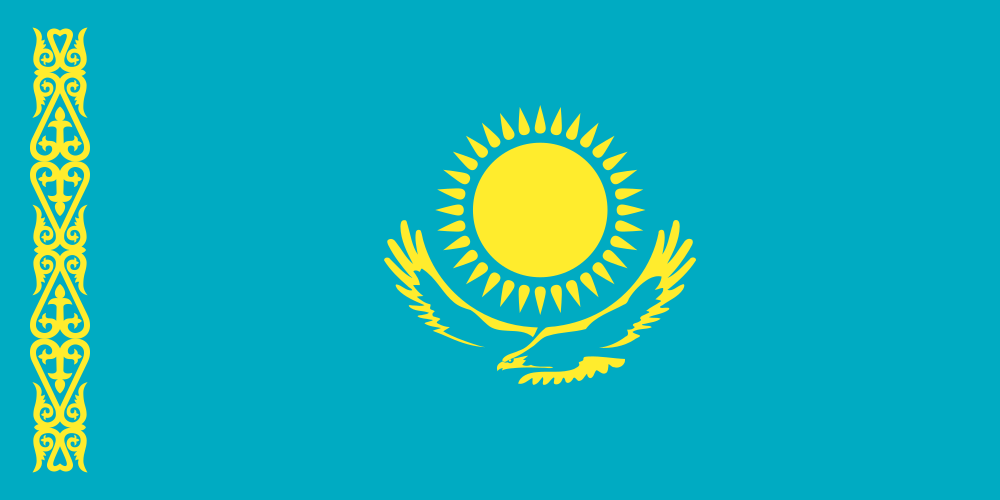
Kazakhstan
Asia · Astana · KZ
Kazakhstan is the largest landlocked country on Earth, a sweep of steppe that runs from the Caspian Sea to the snow peaks of the Tian Shan. Almaty, the old capital, sits against those mountains with orchards, cable cars and a cafe scene built around fast-flowing rivers. The new capital, Astana, rises from the flat northern plain as a showcase of futuristic architecture. The steppe between them is the real interior, endless grassland crossed by rail lines and herded by the horsemen who define the country's culture. Charyn Canyon cuts deep into that tableland, and the mountain lakes of the Almaty region turn turquoise under glaciers. The Kazakh table is built on meat and dairy, with beshbarmak, horse sausage and kumis poured at celebrations. Yurts still pitch for festivals, and the country's sheer scale gives every journey the feeling of crossing a small continent.
Overview
Kazakhstan is a country in Asia. Its capital is Astana and the international dialling code is +7. Languages commonly used in everyday life here include Kazakh and Russian. Local currency is the Kazakhstani Tenge (KZT). Our guide covers 1 airport, including Almaty International Airport. We also list 2 cities in Kazakhstan: Astana and Almaty.
Almaty's Green Belt and the Trans-Ili Mountains
Almaty is a green city pinned between the steppe and the Trans-Ili Alatau, a range that rears up almost from the suburbs. The Kok Tobe hill, reached by a steep funicular, gives the classic panorama of the city and the peaks beyond, while the Medeu high-altitude rink and the Chimbulak ski resort sit a short drive up the mountain road. The Almaty lake, held by a dam at two thousand five hundred metres, turns its famous milky turquoise in high season when glacial silt feeds the water. The city's parks, from the Panfilov ensemble with its timber cathedral to the green swathes near the university, are heavy with apple trees, a nod to the city's claim as the homeland of the modern apple. In summer the mountains pull walkers and paragliders, and in winter they hold skiers within a half hour of the cafés below.
Astana's Glass Skyline on the Windy Plain
Astana, the capital built on the open northern plain at the country's heart, reads like a grand plan made architecture. The Baiterek tower, topped by a golden sphere and an observation egg, dominates the central axis, while the Khan Shatyr entertainment tent, a giant translucent membrane, holds a beach resort under its dome. The National Museum lays out Kazakh history from the Bronze Age steppe to the space programmes launched from Baikonur, only a few hundred kilometres away. Between the monoliths run long avenues, fountains and winter ice rinks, because the temperature drops brutally below minus thirty in January. The city's museums, embankments and modernist towers bend the eye constantly upward. Summer turns the boulevards golden in the endless twilight, and the Ishim river walks fill with families until late. It is a city as much imagined as built.
The Striped Walls of Charyn Canyon
Charyn Canyon, about three hours east of Almaty, is the country's boldest geological showcase, a long wound in the steppe carved by the Charyn River. The main gorge, the Valley of Castles, gathers the most dramatic rock, with reddish towers, striped cliffs and pillars that catch the mind's eye as ruined battlements. A wooden staircase leads down to the river floor, where a stroll between the canyon walls reveals green willow thickets and cold water that flows year-round. The rim spreads grassland, so the viewpoint and the descent feel like stepping from one landscape to another. Winter drapery of ice clings to the cliffs, while summer heat pools on the floor, so the walk is best done early or late. The surrounding steppe holds herders' yurts and the silence that the Kazakh landscape is known for.
The Dombra and the Customs of the Steppe Table
Kazakh culture centres on the horse and the feast, and both find expression in the music that accompanies every celebration. The dombra, a two-stringed lute, carries the folk repertoire, from the long narrative kuis to fast wedding tunes that fill yurts and community halls. The national dish, beshbarmak, is boiled meat set over flat noodles and eaten by hand in the traditional style, with the honoured guest receiving the best cut. Horse milk products run from the fermented kumis, poured for guests and considered both drink and medicine, to the dried forms that keep on long winter rides. Eagle hunting, practised with enormous golden eagles in the Altai and beyond, is less spectacle than the practical partnership of hunter and bird. The guest table, with its pressed wares and endless toasts, is where the Kazakh social contract lives.
The Caspian Shore and Aktau's Coastal Openings
Aktau, built on the Caspian's eastern shore as a Soviet-era port, now anchors the country's beachfront in a landscape of bare desert rolling to the water. The shore around the city mixes gravel and sand creeks where locals swim in summer, while Aktau's own promenade stacks cafes and murals against the sea. North of the city the Mangystau region reveals a different, more austere beauty: the Shakpak-Ata underground mosque cut into a hillside, the Beket-Ata sanctuary in a limestone gorge, and the white cliffs of the Torysh valley, where the wind has sculpted the rock into balls and stacks. The Caspian itself has receded in recent years, exposing new sandbars that change the coastal geometry each season. It is a region for travellers who enjoy wide horizons, empty roads and the sense of a country edge that the oil economy has only partly tamed.
Compare hotels, cover your trip and stay connected.
- Capital
- Astana
- Currency
- Kazakhstani Tenge (KZT)
- Languages
- Kazakh, Russian
- Calling code
- +7
- Internet TLD
- kz
Entry requirements
Check who can enter →See which passports travel visa-free or need a visa to enter Kazakhstan.
Which nationalities can enter Kazakhstan?
Current visa status for tourism for the origins we cover, with links to the detailed requirements.










Airports (1)
All airports →Cities (2)
All cities →Frequently asked questions
Do I need a visa to visit Kazakhstan?
For the origins we track, travellers from Australia, Canada, France, Germany and Italy currently enter Kazakhstan visa-free for tourism, and 4 more origins are visa-free too. Entry rules depend on your passport and the purpose of your trip, so check the current requirements for your own nationality with our entry requirements tool.
What is the capital of Kazakhstan?
Astana is the capital of Kazakhstan, and the country sits in Asia.
What currency is used in Kazakhstan?
You pay with Kazakhstani Tenge (KZT) in Kazakhstan. Exchange rates move day to day, so check the current rate before you change money or use your card abroad.
Which languages do people speak in Kazakhstan?
The languages we list for Kazakhstan are Kazakh and Russian. A couple of greetings in the local language go a long way when you travel, even in cities where another language is widely used.
What is the international dialling code for Kazakhstan?
The dialling code for Kazakhstan is +7 — keep the plus sign when you save the number.
Which airports serve Kazakhstan?
Almaty International Airport (ALA) in Almaty is the airport we cover for Kazakhstan.
Which cities in Kazakhstan do you cover?
Our guide lists 2 cities for Kazakhstan: Astana (capital) and Almaty.