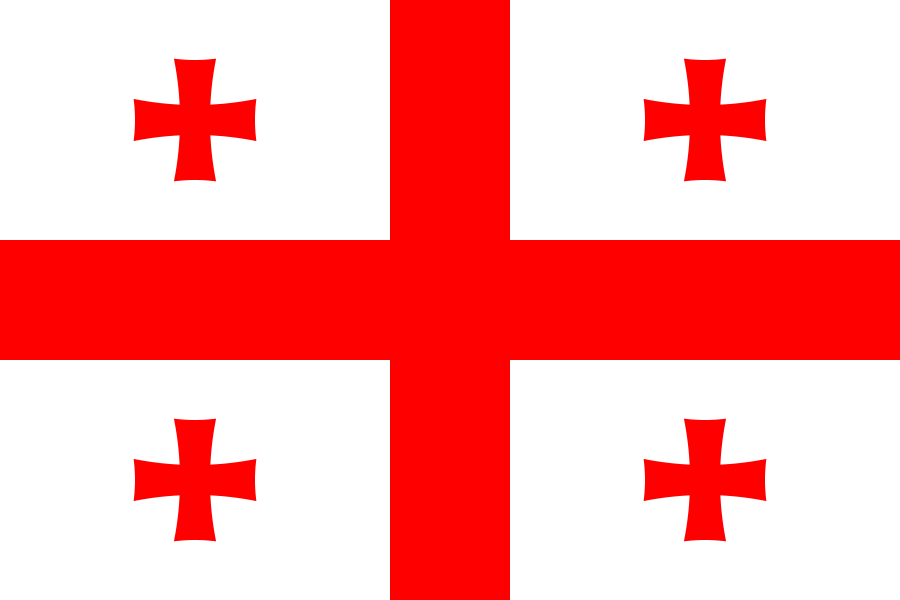
Georgia
Asia · Tbilisi · GE
Georgia is a country of steep contrasts, where the Caucasus peaks shoulder a thousand metres above the Black Sea and every valley seems to hold a tower, a winery or a church carved into the rock. Tbilisi, the capital, spreads across a winding river between warm brick balconies and modern glass, its sulfur baths steaming beneath the old town. The Svaneti highlands of the north shelter some of the oldest stone towers in Europe behind the peaks of Shkhara and Ushguli. Kakheti, the eastern wine country, presses grape and tradition into qvevri clay jars the same way it has for eight thousand years. Beyond the capital, gorges carve through the Lesser Caucasus, and the fertile plains along the Mtkvari grow the crops that fill the country's tables with khachapuri, khinkali and pomegranate. Georgia is small enough to thread into a single road trip, yet its languages, mountain customs and hospitality feel a world apart from anywhere else in the region.
Overview
Georgia is a country in Asia. Its capital is Tbilisi and the international dialling code is +995. Languages commonly used in everyday life here include Georgian. Local currency is the Georgian Lari (GEL). Our guide covers 1 airport, including Tbilisi International Airport. We also list 1 city in Georgia: Tbilisi.
Tbilisi's Sulfur Dome District and Old Silk Roads
Tbilisi's old town climbs from the Mtkvari River in layers, with timber balconies, hanging vines and the cars of a steep funicular riding the hillside. The sulfuric baths that named the city steam beneath brick domes on Abanotubani street, where locals thrash out the quiet soak between appointments. Nearby, the Narikala fortress anchors the ridge and the botanical gardens drop away beneath its walls. The city's history as a Silk Road staging post shows in its churches, caravanserais and the Persian-influenced brickwork of the Meidan district. Cable cars and short walks link the old quarters with the modern avenues of Rustaveli, and the food is a constant draw: wine bars under old arches, bread ovens with tonis puri, and the fried pastry boat of khachapuri hot from the stone. The sulfur quarter glows amber at dusk, and the whole city hums with a stubborn, expressive energy.
Ushguli's Stone Towers and the Svaneti Heights
Svaneti, the high province of northwestern Georgia, hides some of the least spoilt mountain architecture in the Caucasus. Ushguli, often claimed as the highest inhabited village in Europe, strings its stone houses and defensive towers along the valley floor beneath the looming Shkhara massif. The Svan towers, unique to this region, were built as fortified houses, some standing to twenty metres with slate roofs and narrow slits where defenders once watched the passes. The trekking around Mestia and Ushguli threads through these villages, over mountain rivers and up toward glaciers that pour from the peaks. Summer brings wildflower meadows and long light, while winter locks the valleys under snow and the clouds pile against the summits. Svanetian culture, with its own language and songs, is distinct even within Georgia, and the hospitality of the mountain households is famous.
The Woven Vines of Kakheti and Its Qvevri Cellars
Kakheti, the eastern province that anchors Georgian wine, centres on the historic towns of Telavi and Sighnaghi and the Alazani Valley between them. Much of the wine here still ferments in qvevri, the giant clay vessels buried in the cellar earth, a method that predates almost every winemaking tradition on the continent. Vineyards climb terraced foothills, the Georgian grape varieties ripen under dry mountain sun, and the results are amber-hued, tannic and unlike anything bottled elsewhere. Sighnaghi, a hilltop town overlooking the valley, is the region's postcard, its cobbled lanes and red-tiled roofs framed by fortress walls. Cellars along the wine route offer tastings poured straight from the clay vessel, and the chacha grape spirit appears at every toast. The kakhetian table runs long, and the toasts run longer still.
The Black Sea Boulevard of Batumi and Adjara's Coast
Batumi, the port and resort of Adjara, fronts the Black Sea with a palm-lined boulevard that proves how relaxed Georgia's coast can be. The city balances Soviet-era blocks with modern towers, its botanical gardens climbing the green hills behind the shore. Gondolas ride the cable car from the promenade into the hillside, and the Alphabet Tower twists above gardens laid out in the shapes of Georgian letters. The Adjara region stretches beyond the city with coastal villages, tea plantations and the protected forest pressing down to the shoreline. The food is distinctive too: the Adjarian khachapuri, a boat of bread holding egg, cheese and butter, is impossible to eat calmly. Even in the rain the boulevard keeps its appeal, and the ferries and tankers out on the Black Sea remind you that this beach town is also a working port.
Uplistsikhe and the Rock Carved City of the East
Uplistsikhe, an ancient cave town carved into the banks of the Mtkvari, offers one of the strangest architectural monuments in Georgia. The site, inhabited from the first millennium BC, hollowed entire halls, streets and a secret tunnel out of the soft rock, its rooms stacked several storeys deep. What survives is a ghost quarter of carved benches, grain pits and a great hall that could seat the town's elders. The position above the river made it defensible, and the ruins feel a little like walking through a city abandoned to the soil. Climbing the carved steps at dusk, with the floodlights just switching on, you can almost hear the old markets echoing. The view from the top of the outcrop stretches over the valley where the Mtkvari bends past the modern road, tying the site to the same riverside landscape that once fed it.
Compare hotels, cover your trip and stay connected.
- Capital
- Tbilisi
- Currency
- Georgian Lari (GEL)
- Languages
- Georgian
- Calling code
- +995
- Internet TLD
- ge
Entry requirements
Check who can enter →See which passports travel visa-free or need a visa to enter Georgia.
Which nationalities can enter Georgia?
Current visa status for tourism for the origins we cover, with links to the detailed requirements.









Airports (1)
All airports →Cities (1)
All cities →Frequently asked questions
Do I need a visa to visit Georgia?
For the origins we track, travellers from Australia, Canada, Japan, New Zealand and Singapore currently enter Georgia visa-free for tourism, and 3 more origins are visa-free too. Entry rules depend on your passport and the purpose of your trip, so check the current requirements for your own nationality with our entry requirements tool.
What is the capital of Georgia?
Tbilisi is the capital of Georgia, and the country sits in Asia.
What currency is used in Georgia?
You pay with Georgian Lari (GEL) in Georgia. Exchange rates move day to day, so check the current rate before you change money or use your card abroad.
Which languages do people speak in Georgia?
The languages we list for Georgia are Georgian. A couple of greetings in the local language go a long way when you travel, even in cities where another language is widely used.
What is the international dialling code for Georgia?
The dialling code for Georgia is +995 — keep the plus sign when you save the number.
Which airports serve Georgia?
Tbilisi International Airport (TBS) in Tbilisi is the airport we cover for Georgia.
Which cities in Georgia do you cover?
Our guide lists 1 city for Georgia: Tbilisi (capital).