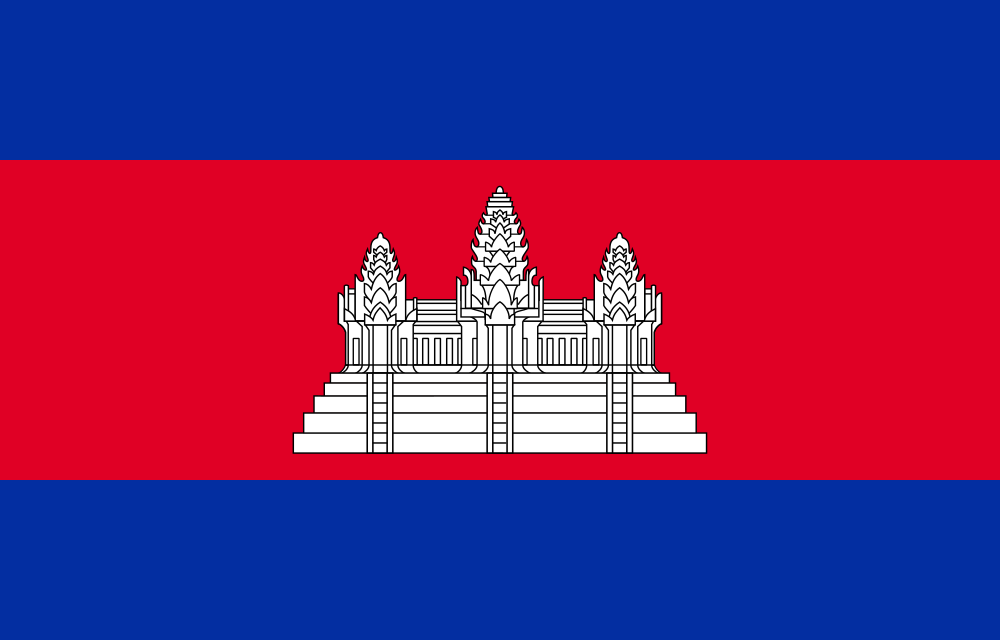
Cambodia
Asia · Phnom Penh · KH
Cambodia weaves the grandeur of the Khmer past into a present that runs on rivers, rice and resilience. The Angkor temples, the greatest religious complex ever built, fan out across the northern lowlands behind Siem Reap, their carved towers rising from the jungle and their galleries stretched over stone. Phnom Penh, the capital, holds the Royal Palace, the National Museum and the riverside boulevards at the junction of the Mekong and Tonle Sap. Across the country, the Mekong cuts through landscapes of flooded forest, floating villages and the wide lake of Tonle Sap, whose seasonal pulse shapes farming and fishing alike. Battambang, the second city, leans into its colonial-era streets and the bamboo-train rides of the surrounding countryside, and the southern coast at Sihanoukville and the islands off it hold the beaches. Cambodian food balances the sour, the salty and the sweet, and the country's warmth, its temples and its river life give every visit a deep sense of place.
Overview
Cambodia is a country in Asia. Its capital is Phnom Penh and the international dialling code is +855. Languages commonly used in everyday life here include Khmer. Local currency is the Cambodian Riel (KHR). We also list 1 city in Cambodia: Phnom Penh.
The Sunken Galleries of the Angkor Complex
Angkor, the ceremonial capital of the Khmer empire, covers hundreds of square kilometres of temples, reservoirs and ancient cities, and its heart is the site complex that stretches around Siem Reap. Angkor Wat itself, the largest religious monument in the world, rises in its iconic five towers over a moat and causeway, its bas-relief galleries telling the myths and battle epics of the Khmer world in long carved sequences. The Bayon, at the ancient centre of Angkor Thom, stacks dozens of enormous smiling faces on its towers, and the jungle-framed Ta Prohm pushes the roots of fig and strangler trees straight through the stonework. The parasol shade of the outer temples, the tiers of Pre Rup and the finely carved Banteay Srei spread to the outer circuit. The site rewards both the dawn crowds at the pool before the wat and the quiet afternoons in the outer temples.
The Sulk of the Tonle Sap and Its Floating Villages
The Tonle Sap, the great lake at Cambodia's heart, reverses its flow every monsoon, expanding across the flooded forest and then draining back south toward the Mekong through the same rivers that feed it. This annual rhythm, unique to this water system, drives the country's fishing economy and creates the floating villages that live on the water all year. The village of Kampong Khleang, built on stilts around the lake's northern shore, stays high and dry above the flood level, while Chong Kneas hosts the daily boats of fishing families, schools and houses that winter on the lake. The villagers catch the lake's fish with nets and cages that shift with the water, and the flooded forest hides birds, snakes and the season's young fish. The lake view at sunset, with the palms of the floodplain breaking the horizon, colours the whole country's sense of scale.
The Riverscape Promenades of Phnom Penh
Phnom Penh, spread along the confluence of the Mekong and Tonle Sap rivers, is Cambodia's working, watchful capital. The Royal Palace complex lines the riverfront with its gardens, the throne hall and the Silver Pagoda, its floor tiled in silver that catches the afternoon light. The National Museum across the way holds the masterpieces of Khmer stone and bronze that survey the country's sculptural history. The promenade along the Sisowath quay runs past the old French quarter and the newer bars that have made the waterfront the city's social spine. The central market's dome and the old station mark the colonial plan, while the islands in the river keep the city's views mixing old and new. The temple on top of the city's namesake hill stands where the foundation was laid, and the river at dusk keeps the whole city oriented to the water.
The Bamboo Train and Colonial Baked Brick of Battambang
Battambang, Cambodia's second city, ambles along a grid of French-era shop-houses and faded colonial villas, its riverfront and the quiet traffic of its markets giving it a gentler pace than the capital. The old French quarter holds the governor's residence, the shuttered bank buildings and the cafe streets that sketch the town's vanished prosperity. The signature experience is the bamboo train: a flat platform of slats on two wheels, pushed by a small engine along a single disused rail line through the rice country, with the crossing points where two trains must lift one off the track negotiated by hand. The countryside hides the shells of old brickworks and rice mills that once fed the region's trade. The small temples of the town and the Bat Cave hill, where thousands of bats stream out at sunset, complete a region less visited than the Angkor circuit.
The Coves and Coral Gardens of Koh Rong Islands
Off the coast west of Sihanoukville, the islands of Koh Rong and Koh Rong Sanloem hold some of the softest sand and clearest water in the country. Koh Rong's main beach, a crescent of white sand that runs several kilometres through palm groves, holds the calm swimming and the casual sunset bars. The interior folds tropical forest over hills, and the far-side coves drop into shallow reef gardens where snorkellers watch fish among the coral heads. Koh Rong Sanloem, smaller and quieter, is where the paths end in low-key beach stays and the night-time bioluminescence of the plankton fills the shallows. Boats shuttle between the islands and the mainland several times a day, and the fishing villages still work the boats that supply the beach restaurants. Between the diving, the laid-back nights and the jungle walks, the Koh Rong pair delivers Cambodia's coast in two speeds: party and peace.
Compare hotels, cover your trip and stay connected.
- Capital
- Phnom Penh
- Currency
- Cambodian Riel (KHR)
- Languages
- Khmer
- Calling code
- +855
- Internet TLD
- kh
Entry requirements
Check who can enter →See which passports travel visa-free or need a visa to enter Cambodia.
Which nationalities can enter Cambodia?
Current visa status for tourism for the origins we cover, with links to the detailed requirements.










Cities (1)
All cities →Frequently asked questions
Do I need a visa to visit Cambodia?
For the origins we track, Cambodia requires a visa for tourism (Australia: e-visa, Canada: e-visa, India: e-visa, Japan: e-visa and Morocco: e-visa). Entry rules depend on your passport, so confirm the current requirements for your own nationality with our entry requirements tool.
What is the capital of Cambodia?
Phnom Penh is the capital of Cambodia, and the country sits in Asia.
What currency is used in Cambodia?
You pay with Cambodian Riel (KHR) in Cambodia. Exchange rates move day to day, so check the current rate before you change money or use your card abroad.
Which languages do people speak in Cambodia?
The languages we list for Cambodia are Khmer. A couple of greetings in the local language go a long way when you travel, even in cities where another language is widely used.
What is the international dialling code for Cambodia?
The dialling code for Cambodia is +855 — keep the plus sign when you save the number.
Which cities in Cambodia do you cover?
Our guide lists 1 city for Cambodia: Phnom Penh (capital).