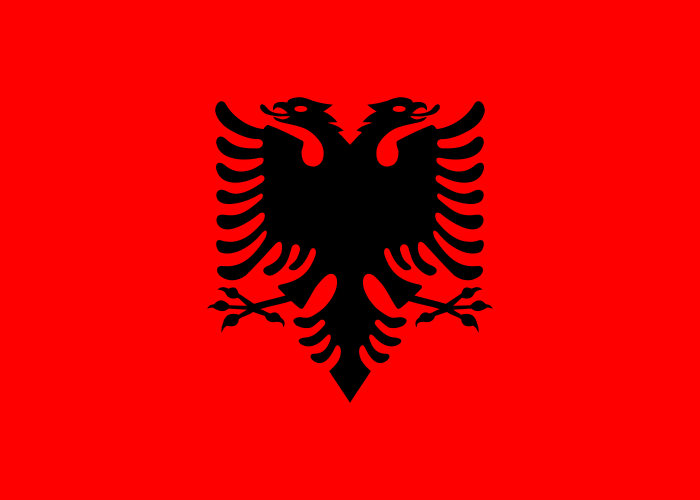
Albania
Europe · Tirana · AL
Albania is a small Balkan country that packs mountains, coastline and centuries of tangle into a compact, affordable whole. Tirana, the capital, paints its buildings in bright colours and hides bunkers and museums beneath the surface of its modern energy. The country's south frontage along the Ionian Sea, the Riviera, strings cliff-hugging roads, olive groves and beaches beneath the old Ottoman hill towns. Berat and Gjirokaster, both carved on UNESCO's list, stack their white stone houses against fortress slopes. Inland, the road climbs to alpine villages and the dramatic spectacle of the Blue Eye spring, and the Butrint ruins on the south coast hold more than two thousand years of Mediterranean history. Long isolated and now wide open, Albania surprises most visitors with its warmth, its wild beauty and the sense of discovery that still clings to its least-developed corners.
Overview
Albania is a country in Europe. Its capital is Tirana and the international dialling code is +355. Languages commonly used in everyday life here include Albanian. Local currency is the Albanian Lek (ALL). We also list 1 city in Albania: Tirana.
The Riviera's Cliff Roads Between Dhermi and Himare
The Albanian Riviera is a fifty-kilometre ribbon of road that laces along the Ionian coast, dropping from the heights of the Llogara pass to the bays of the south. Between the whitewashed villages of Dhermi and Himare the road hangs over turquoise coves, olive terraces and beaches that still feel surprisingly unbuilt. Each small town keeps its own harbour, its own sandy curve and its own seaside fish restaurants grilling red bream over charcoal. The summer season brings crowds to the most accessible strips, but a morning swim in the quiet bays of the corner, away from the car parks, still feels like a discovery. Behind the coast the mountains of the Ceraunian chain rise steep and pine-covered, and the whole drive from Sarande to Vlore ranks as one of the most beautiful coastal roads in Europe.
Berat's Ottoman Windows Stacked Behind Stone Walls
Berat earns its nickname as the city of a thousand windows, with white Ottoman houses climbing the green slopes below its medieval castle, each upper floor pierced by a wall of arched windows. The town's bazaar street and its orthodox churches and mosques cluster along the banks of the Osum river, connected by the ancient stone bridge. Inside the castle hill, an old town within the walls holds narrow lanes, family homes and views out over the valley and the river bend. The churches of the National Iconographic Museum display works of the post-Byzantine painters who worked here for centuries. By day the town is calm and walkable, and in the evening the lit windows of the hillside turn Berat into a stair-step city of gold light. It is one of the most approachable stops in the Balkans for a slow wander.
Tirana's Painted Squares and the Bunkers Turned Museums
Tirana before and after the end of the last century reads like two different cities. The old regime left a grid of drab apartment blocks, but the newer era painted them in bright pastels and stripes, and the pedestrian sweep of Skanderbeg Square now anchors a lively centre of museums, cafes and street life. The city's past is never far: hundreds of concrete bunkers dot the whole country, and Tirana has turned several into installations and a history museum that uses the brutal spaces to tell uncomfortable stories. The National History Museum and the pyramid-shaped building on the city's skyline mark different attempts to reinvent the centre. Around the edges, the green hills of the Dajti range rise straight behind town, and a cable car climbs for a hilltop view over the capital's sprawling, colourful plan.
The Blue Eye Spring and the Waterfalls Above the South
The Blue Eye spring near the village of Muzine is one of the most startling sights in the Balkans: a deep pool of cobalt blue into which a clear river vanishes, the water so transparent that the hole at its centre looks like the eye of a needle. The setting is a quiet riverside park of plane trees, bridges and picnic tables, and the pool stays astonishingly cold whatever the season. Higher into the southern mountains, the waterfalls of the surrounding valleys drop over stepped rock faces in summer and run full with snowmelt in the spring. The road link from the spring over the hill passes goat herds, stone villages and roadside grills where locals sell fresh mountain cheese and lamb. The region is the green heart of southern Albania, and it makes a perfect cool break from the coast.
Gjirokaster's Stone Terraces and the Castle High on the Hill
Gjirokaster stacks its stone roofs up the steep hillside in the Drino valley, a town of grey slate and narrow lanes that the Ottoman world left remarkably intact. The castle crowns the summit, its vast walls holding a military museum, a captured plane and panoramic views over the valley and the distant mountains. Below, the cobbled streets wind past the characteristic tower houses, several of which are open as museums of the town's old domestic life, with their wooden galleries, courtyards and carved ceilings. The old bazaar street is a lively row of stone workshops and coffee houses. The steep climbs between the levels give the town a physical rhythm; boots and an early start repay the effort. Gjirokaster feels like a fortress against time, and its hilltop view is the finest in the Albanian south.
Compare hotels, cover your trip and stay connected.
- Capital
- Tirana
- Currency
- Albanian Lek (ALL)
- Languages
- Albanian
- Calling code
- +355
- Internet TLD
- al
Entry requirements
Check who can enter →See which passports travel visa-free or need a visa to enter Albania.
Which nationalities can enter Albania?
Current visa status for tourism for the origins we cover, with links to the detailed requirements.









Cities (1)
All cities →Frequently asked questions
Do I need a visa to visit Albania?
For the origins we track, travellers from Australia, Canada, France, Germany and Italy currently enter Albania visa-free for tourism, and 3 more origins are visa-free too. Entry rules depend on your passport and the purpose of your trip, so check the current requirements for your own nationality with our entry requirements tool.
What is the capital of Albania?
Tirana is the capital of Albania, and the country sits in Europe.
What currency is used in Albania?
You pay with Albanian Lek (ALL) in Albania. Exchange rates move day to day, so check the current rate before you change money or use your card abroad.
Which languages do people speak in Albania?
The languages we list for Albania are Albanian. A couple of greetings in the local language go a long way when you travel, even in cities where another language is widely used.
What is the international dialling code for Albania?
The dialling code for Albania is +355 — keep the plus sign when you save the number.
Which cities in Albania do you cover?
Our guide lists 1 city for Albania: Tirana (capital).